

Smart Glass Manufacturing 2025: How Automation and AI Are Transforming Decorative Glassware Production
The Evolution of Smart Glass Manufacturing
In 2025, the decorative glassware industry is entering an era of remarkable transformation. What was once a highly manual and artisan-driven process has evolved into a world of smart factories, AI-assisted production, and digital precision.
At HONORLIVING Glass, we see this shift as a fusion of craftsmanship and technology—a balance between human creativity and machine intelligence.
From Manual Crafting to Intelligent Automation
For decades, decorative glass production relied heavily on hand-blowing and manual finishing. Today, advanced robotic systems are capable of reproducing intricate shapes and textures with astonishing consistency.
These systems not only boost productivity but also ensure precise thickness, symmetry, and surface smoothness in every piece.
💡 Read more: From Concept to Creation: How HONORLIVING Brings Honor into Everyday Living
The Role of AI in Design and Quality Control
AI-driven image recognition tools can now detect micro-bubbles or color inconsistencies invisible to the human eye.
At the same time, machine learning algorithms help designers visualize new color gradients and textures before physical prototypes are made.
Leading manufacturing insights and we can understand that AI quality control reduces waste and energy use by over 25% in precision industries.
Key Technologies Driving the 2025 Transformation
Robotic Automation and Smart Assembly Lines
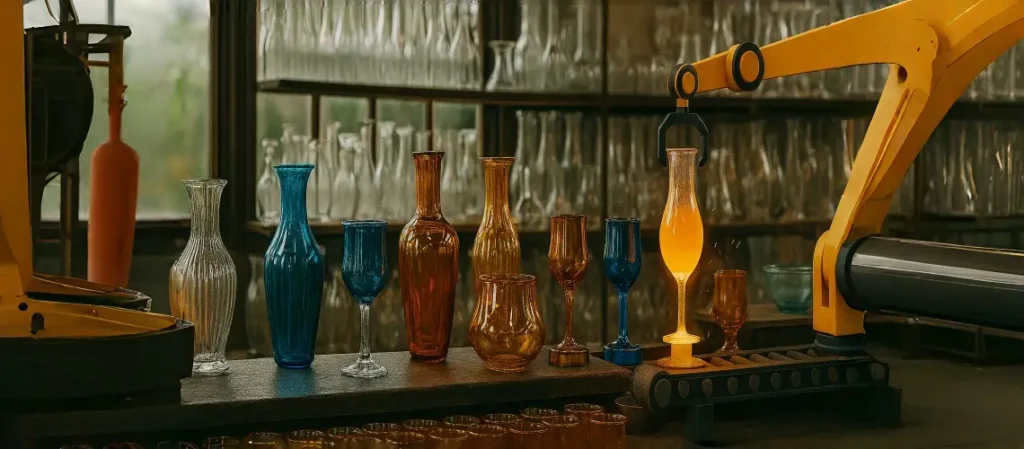
Modern decorative glass plants integrate robotic arms that handle molding, annealing, and finishing steps seamlessly.
Automated lines are equipped with sensors that monitor temperature and viscosity in real time—ensuring every vase, bowl, or ornament achieves the ideal clarity and strength.
IoT Integration and Predictive Maintenance
IoT-enabled furnaces and forming stations transmit live data to central dashboards, helping operators anticipate mechanical wear or material variation.
According toIoT-enabled furnaces and forming stations transmit live data to central dashboards, helping operators anticipate mechanical wear or material variation.
According to Siemens’ Digital Twin research, predictive maintenance can reduce production downtime by nearly 40%., predictive maintenance can reduce production downtime by nearly 40%.
Sustainable and Energy-Efficient Glass Production
Smart manufacturing is also greener. AI-assisted melting controls and recycled glass tracking systems are minimizing CO₂ emissions and material loss.
How AI Enhances Decorative Glassware Creativity
Generative Design for Glass Patterns
AI-based generative tools are allowing designers to explore thousands of decorative possibilities—simulating etching effects, embedded pigments, and layered transparency.
This technology accelerates innovation while keeping the human touch alive in every pattern.

Data-Driven Customization for Global Markets
Smart design platforms use customer preference data from different regions to adapt color palettes and styles to global tastes.
For example, European buyers often prefer frosted minimalism, while Middle Eastern clients appreciate richly tinted and reflective designs.
💡 See also: How to Choose the Right Glassware for Wholesale & Bulk Orders
Real-World Applications and Case Studies
Smart Glass in Hospitality and Home Décor
Hotels and restaurants are increasingly adopting decorative smart glass for lighting, partitions, and tabletop designs. These pieces adjust their transparency and glow dynamically, enhancing ambiance and energy efficiency.
Collaboration Between Designers and Engineers
HONORLIVING Glass has invested in integrated digital workstations where designers and engineers collaborate in real time, shortening prototype development from weeks to hours.
💡 Related reading: Metal, Wood, and Glass in Contemporary Vase Design
The Future of Glass Manufacturing Beyond 2025
What’s Next: Quantum Design, Smart Surfaces, and Beyond
The next wave of innovation lies in quantum-enhanced modeling and “smart surfaces” capable of adjusting their hue or reflectivity via embedded nanomaterials.
Such technologies will merge functionality with beauty in ways previously unimaginable.
Why HONORLIVING Invests in Smart Glass Innovation
As a leader in glassware design and export, HONORLIVING continues to invest in digital transformation—combining advanced automation with design excellence to deliver smarter, more sustainable glass art to global clients.
💡 Learn more: Global Glassware Market Outlook 2026: Growth Drivers & Consumer Trends
Conclusion
Smart manufacturing isn’t replacing artistry—it’s redefining it.
As automation, AI, and sustainability converge, the decorative glassware industry is poised for a decade of efficiency, beauty, and innovation.
At HONORLIVING Glass, we believe the future of glassmaking is not just smart—it’s inspired.
Looking for supplier? → link to https://supplier.honorlivingglass.com
